
Summary
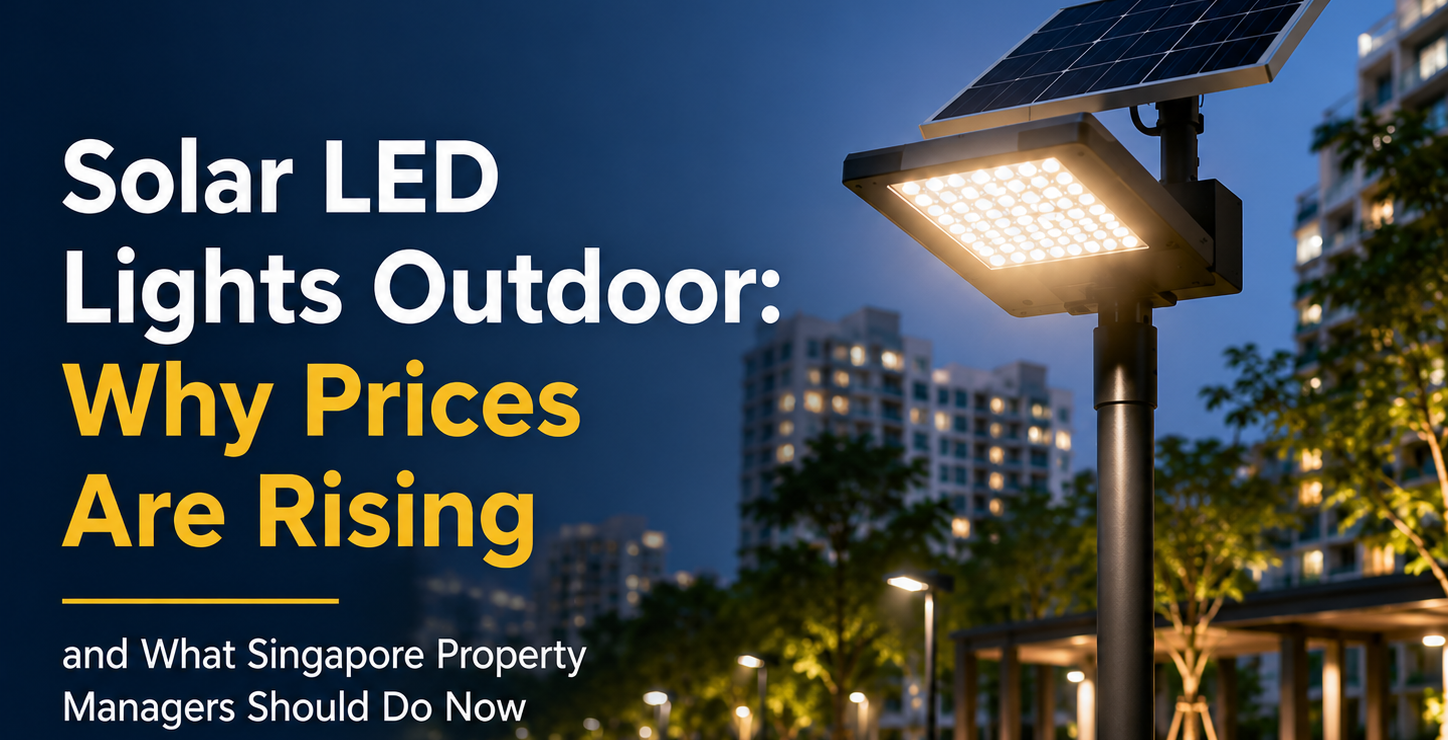
Solar LED lights outdoor are widely used across Singapore for carparks, driveways, pathways, garden landscapes, lamp posts, and construction worksites because they require zero cable installation, eliminate grid electricity costs, and can be installed within days. Prices are rising due to lithium battery costs surging from USD 80,000 to over USD 200,000 per tonne, and solar panel raw material costs increasing 5 to 10%. Suppliers are now holding quotes for one week at a time. According to Singapore’s Energy Market Authority (EMA), Singapore receives an average solar irradiance of 1,580 kWh per square metre per year — one of the highest in Asia — making it well suited for solar powered outdoor lighting year-round. Key buying factors include battery backup capacity (minimum two nights for Singapore conditions), lumen output, IP rating (IP65 minimum, IP67 for in-ground or ground-level fixtures), motion sensor configuration, and local after-sales support. StarLED Technology has supplied and installed project-grade solar LED lights outdoor for Singapore Botanic Gardens, Fort Canning Park, Bukit Canberra Sports Hub, Marina Bay, La Suisse Condo, Valley Point Shopping Centre, and the new PSA port development at Tuas South.
If you are managing an outdoor space in Singapore — whether it is a condo driveway, a carpark, a worksite road, a park pathway, or a hotel garden — solar LED lights outdoor have become one of the most practical lighting upgrades available today.
No cable pulling. No grid consumption. No monthly electricity bill for those fixtures.
But right now, there is something more urgent to understand. Solar LED lights outdoor are getting more expensive, and the window to lock in current pricing is shrinking fast.
Here is what is actually driving this, and what it means if you are planning a lighting project this year.
Why Solar LED Lights Outdoor Are Getting More Expensive
The global supply chain has been under sustained pressure since recent military conflicts disrupted trade routes and raw material flows. For the solar lighting industry specifically, two cost categories are feeling the squeeze most severely.
1. Lithium Prices Have More Than Doubled
Lithium is the core material inside the batteries that make solar LED lights outdoor function. Without a reliable lithium battery, a solar light cannot store energy during daylight hours and release it at night.
Lithium prices have surged from around 80,000 RMB per tonne to over 200,000 RMB per tonne — a rise of more than 150%. This cost is now embedded into every solar light unit on the market, and suppliers have no choice but to pass it on.
2. Solar Panel Raw Materials Are Up 5 to 10%
The photovoltaic materials used in solar panels — including polysilicon and aluminium frames — have risen by 5 to 10% across the board. For a single bollard light or solar lamp post, this may seem small. Across a project of 20, 50, or 100 units, it adds up to a significant cost difference.
3. Suppliers Are Holding Prices for One Week at a Time
This is the part that catches most property managers and procurement teams off guard. Traditionally, a supplier quote would hold for 30 to 60 days. Today, many overseas manufacturers and local distributors are revising prices weekly.
A quotation submitted on Monday may not be valid by Friday.
If your project is still in the approval process, the price you were shown two weeks ago may no longer be the price you will be charged.
Why Building Managers Are Turning to Solar LED Lights Outdoor Right Now
Despite rising prices, demand for solar LED lights outdoor in Singapore has not dropped. If anything, it has accelerated. Here is why.
Energy Costs Are Climbing Alongside Material Costs
Property operating costs are rising across the board. Grid electricity is getting more expensive, and outdoor lighting is one of the easier line items to address without a major renovation.
Facilities managers we speak to are increasingly asking two questions:
- Can we install motion sensors to cut idle energy consumption during low-traffic hours?
- Can we switch to solar to remove the electricity cost for outdoor fixtures entirely?
Both are smart responses to rising costs. Solar LED lights outdoor address the second question directly and permanently.
No Cable Means No Disruption and No Trenching Cost
One of the biggest misconceptions about solar outdoor lighting is that the decision is primarily environmental. For most of our clients, the case is practical first.
Running cables to outdoor carparks, garden pathways, boundary perimeters, or lamp post positions requires civil works. That means trenching, waterproofing, conduit laying, and reinstatement of surfaces. For a typical condo or commercial property, this civil work alone can add tens of thousands of dollars to a project before a single light is installed.
Solar LED lights outdoor eliminate that cost entirely. Each unit is self-contained. The panel charges the battery during daylight. The light activates at dusk. No grid connection required. No cable pulling. No disruption to residents or ongoing site operations.
Installation Completed in Days, Not Weeks
Because there is no cable infrastructure to build, solar LED lights outdoor — whether solar street lights, solar flood lights, or solar bollard lights — can be installed far faster than wired alternatives. For urgent projects ahead of a key inspection, an occupation permit, or a new season launch, this speed matters.
We recently completed a solar split street light installation across a large reclamation site at Tuas South, where the new PSA port is being developed. The roads were completely unlit at night. The nearest power access points were kilometres away, and pulling cables was not commercially viable. Solar units were installed with zero cable work, and the roads were safely lit within days.
Singapore’s Solar Advantage: What the Data Says
A common concern is whether solar powered outdoor lights can perform reliably in Singapore’s tropical weather — cloudy seasons, heavy monsoon rain, high humidity.
The data says yes.
According to the Singapore Energy Market Authority (EMA), Singapore receives an average annual solar irradiance of 1,580 kWh per square metre — equivalent to approximately 4.38 peak sun hours per day. This places Singapore among the most solar-productive locations in Asia.
Commercial-grade solar LED lights outdoor are designed specifically for equatorial and tropical climates. A well-specified unit charges adequately even on partially overcast days, and the battery is sized to hold enough reserve power for two to three consecutive nights without direct sunlight.
Singapore has also set a national solar deployment target of 3 gigawatt-peak by 2030 — a target underpinned by the consistent reliability of solar energy in our climate. As of mid-2025, there were over 12,000 solar PV installations island-wide, with strong adoption across town councils, public housing common services, and the non-residential private sector.
IP67-rated units are fully weatherproof and built to withstand Singapore’s rainfall intensity and year-round UV exposure. La Suisse Condo installed solar pathway lights with us two years ago. Zero maintenance calls since installation.
What Types of Solar LED Lights Outdoor Are Available
Not all outdoor spaces have the same requirements. Here is a practical overview of the main product types used in Singapore commercial, government, and residential projects — with links to our product pages for each category.
Solar Street Lights
Designed for driveways, carparks, access roads, and public walkways where high lumen output and wide-area coverage are the priority. Available in all-in-one designs — where the panel is mounted directly on the light head — and split designs, where the solar panel and light are two separate units, allowing the panel to be angled independently for maximum sun exposure regardless of pole placement or orientation.
Split designs are the preferred choice for large open sites or where poles cannot be positioned to face direct sunlight. Solar street lights eliminate the need for underground power cables, which significantly reduces installation cost and timeline on large outdoor projects.
Browse our solar street lights →
Solar Bollard Lights and Garden Bollard Lights
Low-level pathway fixtures suitable for pedestrian areas, garden walkways, condo common spaces, and landscaped outdoor environments. Solar bollard lights are taller, sturdier post-mounted fixtures designed for pathways and driveways where visibility and durability are priorities. Solar garden lights are generally lower and more decorative, suited for garden beds, landscaping, and lifestyle settings.
We installed solar bollard lights at Valley Point Shopping Centre to replace old wired bollards with corroded bases. No trenching. No surface reinstatement. The upgrade was completed without disruption to mall operations.
Browse our solar bollard lights →
Solar Flood Lights
High-output eco-friendly fixtures for wide-area coverage. Used across open carparks, building facades, sports facilities, construction worksites, and security-sensitive perimeter areas where bright, directed illumination is needed over a large zone. Solar flood lights are among the most requested product types by M&E contractors for worksite and outdoor commercial lighting projects.
For carparks requiring high lumen output across open areas, solar flood lights are the most effective choice. For covered or basement carparks where panels cannot access sunlight, grid-powered LED flood lights remain the better option.
Browse our solar flood lights →
Solar Lamp Posts
Traditional and contemporary post designs for streets, parks, hotel driveways, and open public spaces. Solar lamp posts are a popular choice for government park projects and property developers who need landscape-integrated lighting without underground cable infrastructure. The ATHENA and SOL-DIA solar lamp post models are among our most regularly specified for NParks and hotel driveway applications.
Solar lamp posts — also called solar powered street lights or solar power lamp posts — deliver the full visual presence of a traditional street lamp, with zero grid connection and zero electricity running cost.
Solar In-Ground Lights
Flush-mounted recessed fixtures embedded into pathways, driveways, and feature areas. Rated IP67 for areas with heavy foot traffic or occasional surface water. We installed solar in-ground lights at Marina Bay for a floating pontoon project where mains power access was not practical. Units operate at as low as 0.3W and have required zero maintenance since installation.
In-ground solar lights are also used at pedestrian crossings, entrance forecourts, and landscape feature zones in luxury condominiums and hotel grounds.
Browse our solar in-ground lights →
Solar Garden and Landscape Lights
Decorative accent lighting for parks, landscaped areas, hotel grounds, and outdoor gardens. Solar garden lights and solar spike lights are popular for marking garden edges, illuminating planting beds, and adding ambient light to outdoor walkways without wiring. Singapore Botanic Gardens and NParks projects have used solar options where cable installation would disturb root systems or heritage planting beds.
Solar landscape lighting is also an eco-friendly choice for church grounds, community spaces, and residential estates where aesthetic integration matters as much as functionality.
Browse our solar garden and landscape lights →
Solar Wall Lights
Surface-mount fixtures for building exteriors, entrance gates, stairwells, and perimeter walls. Solar wall lights with built-in motion sensors are a popular choice for security-sensitive areas, as the light activates at full brightness when movement is detected and dims during inactive periods — extending battery life significantly.
For outdoor stairwells and building corridors where wiring is costly to install, solar wall lights provide a fully self-contained solution with no electrical works required.
Browse our solar wall lights →
What to Consider Before Buying Solar LED Lights Outdoor
Buying the wrong specification is the most common and most costly mistake in outdoor solar lighting. Here is what to clarify before committing to any supplier.
Battery Type and Backup Capacity
Not all solar batteries perform equally. Lithium iron phosphate (LiFePO4) batteries are the commercial-grade standard, with a rated lifespan of 2,000 or more charge cycles — roughly 5 to 8 years under normal use. Lower-grade nickel-metal hydride or lead-acid alternatives may need replacement within 2 to 3 years.
Confirm how many nights the light can operate without solar recharging. For Singapore’s occasional multi-day overcast periods, a minimum of two nights of backup capacity is the recommended specification for commercial installations.
Lumen Output and Coverage Area
Brightness for solar lights is measured in lumens, not watts. A 40W solar street light may produce anywhere from 3,000 to 6,000 lumens depending on the LED chip quality and optical design. Match the lumen output to the area you need to cover — do not rely on wattage alone as a comparison metric across different brands.
Motion Sensor Configuration
Most solar LED lights outdoor can be configured with a motion sensor mode where the light dims to 20 to 30% during low-traffic periods and brightens to 100% when movement is detected. This significantly extends battery runtime and is particularly useful for outdoor carparks, stairwells, and pedestrian pathways that are not continuously active through the night.
IP Rating for Singapore’s Climate
For any permanent outdoor installation in Singapore, specify IP65 as the minimum. IP65 provides full protection against dust and water jets from any direction. For ground-level fixtures, in-ground lights, or any installation near water features, IP67 is required. Do not accept fixtures rated below IP65 for outdoor commercial use.
The EMA Solar Irradiance Map provides real-time data on solar energy output across Singapore — useful for verifying expected panel performance at a specific site location before finalising specifications.
Warranty, Lifespan, and Local After-Sales Support
Solar LED lights outdoor have two components with different lifespans. LED fixtures are typically rated for 50,000 hours or more — roughly 10 to 12 years. Batteries require replacement every 5 to 8 years depending on the battery type and usage pattern.
Confirm the warranty period for both components separately. And critically, confirm that your supplier holds local stock for battery replacement. An overseas-only warranty or a supplier with no Singapore presence is not practical for a commercial property that needs a responsive maintenance partner.
StarLED Technology has been supplying solar LED lights outdoor in Singapore since 2009 and maintains local stock and technical support for all projects we supply.
The Pricing Reality: Why Acting Sooner Matters
Projects we are completing today were priced at rates from two months ago.
Clients who confirmed their orders early are locking in savings at last quarter’s cost. Those still in the internal approval process are watching the numbers move.
This is not a sales tactic. It is the reality of how the solar supply chain is working right now. Lithium costs are unlikely to reverse in the near term. Raw material pressures are structural, not seasonal. And with suppliers revising prices weekly, the gap between a quote and a confirmed purchase order is the variable that matters most.
If your property has outdoor areas that are currently under-lit, running on old grid-connected fixtures, or generating unnecessary electricity and maintenance costs — solar LED lights outdoor are worth evaluating now, not in six months.
StarLED Technology: Solar LED Lights Outdoor for Singapore Commercial and Residential Projects
StarLED Technology has been supplying and installing project-grade solar LED lights outdoor across Singapore since 2009. Our clients include NParks, JTC Corporation, Bukit Canberra Sports Hub, Singapore Botanic Gardens, Fort Canning Park, Marina Bay, luxury condominiums, hotels, MNC construction firms, and MCST managing agents.
We do not just supply. We conduct site inspections, specify the right product for each application, and provide local after-sales support. Every recommendation is made to serve long-term reliability, not just the immediate sale.
If you are evaluating solar LED lights outdoor for a carpark, driveway, pathway, worksite, garden landscape, or lamp post position, WhatsApp us at +65 6100 1917 for a free site inspection and quotation.
Email: mgt@starledtechnology.com
Frequently Asked Questions: Solar LED Lights Outdoor in Singapore
Do solar LED lights outdoor work in Singapore’s weather?
Yes. According to the Singapore Energy Market Authority (EMA), Singapore receives an average annual solar irradiance of 1,580 kWh per square metre — equivalent to around 4.38 peak sun hours per day. Commercial-grade solar LED lights outdoor are designed for tropical climates and charge adequately even on partially cloudy days. Well-specified units carry enough battery reserve to operate for two to three nights without direct sunlight. Specify IP65 minimum for general outdoor use and IP67 for ground-level or partially exposed fixtures.
How long do solar LED lights outdoor last in Singapore?
Solar panels typically last 15 to 25 years. LED fixtures are rated for 50,000 hours or more, equivalent to roughly 10 to 12 years. Commercial-grade lithium iron phosphate (LiFePO4) batteries last 5 to 8 years under normal use, rated for 2,000 or more charge cycles. Lower-grade batteries may need replacement in 2 to 3 years. Always confirm the battery type and warranty period for both the LED and battery components separately before purchase.
What solar lights are suitable for condo and MCST common areas in Singapore?
Solar bollard lights, solar garden lights, and solar wall lights are the most commonly used for condo and MCST common areas including pathways, carparks, gardens, and building entrances. These require no wiring, reducing installation costs and minimising disruption to residents. For open carparks requiring higher lumen output, solar flood lights or solar street lights are more appropriate.
What is the difference between all-in-one and split solar street lights?
An all-in-one solar street light integrates the solar panel, battery, and LED head into a single unit mounted on the pole. A split solar street light separates the panel from the light head, allowing the panel to be independently angled toward maximum sunlight exposure regardless of pole placement or orientation. Split designs are recommended for large open sites or where poles cannot face direct sunlight — such as shaded roads or sites with fixed pole positions.
Why are solar outdoor light prices rising in 2025?
Two main factors are driving price increases. First, lithium prices have surged from around USD 80,000 per tonne to over USD 200,000 per tonne due to global supply chain disruptions. Lithium is the core material in solar batteries. Second, raw materials used in solar panel production have risen by 5 to 10% across the board. As a result, many suppliers are now revising quotations weekly rather than holding prices for 30 to 60 days.
Can solar LED lights outdoor be used for construction worksites in Singapore?
Yes. Solar LED lights outdoor are well suited for construction worksites, especially where grid power is distant or where pulling cables is not commercially viable. Solar flood lights and solar split street lights are the most commonly specified types, providing high-lumen outdoor flood lighting with zero cable installation. StarLED Technology supplied solar split street lights for the new PSA port development at Tuas South, where power access points were kilometres away from the roads requiring illumination.
What maintenance do solar LED lights outdoor require?
Commercial-grade solar LED lights outdoor require minimal maintenance. The primary task is periodic cleaning of the solar panel surface — dust and debris accumulate and reduce charging efficiency. Battery replacement is required every 5 to 8 years depending on grade. LED components rarely require attention within the first 10 years. Choosing a supplier with local stock and Singapore-based after-sales support is essential for commercial properties.
What IP rating should I specify for solar outdoor lights in Singapore?
For general outdoor installations in Singapore, specify IP65 as the minimum. IP65 provides full dust protection and resistance against water jets from any direction — suitable for open carparks, pathways, garden bollard lights, and solar lamp posts. For ground-level in-ground lights or fixtures near water features, IP67 is required. Do not accept fixtures rated below IP65 for any permanent outdoor commercial installation.
Are solar powered street lights cost effective compared to grid-powered alternatives?
Yes, particularly for outdoor and public spaces in Singapore. Solar powered street lights eliminate trenching, cabling, and ongoing electricity costs entirely. While the upfront cost is higher, the long-term savings on energy bills and maintenance make them significantly more cost effective over a 5 to 10 year period — especially for large-scale outdoor projects, government parks, and properties where civil works for cable installation would be expensive. View our full solar lights range for project-based specifications.
What solar lights are best for outdoor carparks in Singapore?
Solar flood lights and solar street lights are the most effective for open outdoor carpark illumination, providing wide-angle, high-lumen output across large areas. For covered or basement carparks where solar panels cannot access sunlight, grid-powered LED flood lights are more suitable. Motion sensor configurations are recommended for all carpark solar lights to extend battery life during low-traffic hours overnight.

